Introduction
This workshop is dedicated to Democracy, Citizenship and Critical Thinking. Its goal is to explore how young people, aged between 15 and 25, can become active and informed participants in democratic life, both at the national and European levels. This course is part of the CERV project Youth DemocrAID, which aims to strengthen youth participation in democratic life and promote active citizenship. In a time of political disillusionment, fake news and declining voter turnout, particularly among young people, it is crucial to provide new generations with the tools to navigate civic life with awareness and responsibility. While today’s youth are increasingly exposed to complex social and political dynamics, many lack clarity on how democratic systems function or how to engage with them meaningfully. This is why it is essential to invest in democratic education and critical thinking.
What is youth empowerment through citizenship?
Empowerment in this context means equipping young people with the skills, knowledge, and confidence to become active citizens. It involves understanding how institutions function, how decisions are made, and how individual and collective action can shape society. Citizenship is not just a legal status, but an active relationship between the individual and the state, based on rights, duties, and participation. Empowering youth also means enabling them to critically assess information, resist misinformation, and make informed decisions that reflect their values. When young people understand how democracy works and how they can contribute, they are better prepared to influence public life constructively.
Democracy and critical thinking: building resilient citizens
Democracy depends on an informed and engaged citizenry. Youth leadership, in this sense, is about fostering critical thinkers who can question, analyze, and contribute to democratic life with integrity. In an era dominated by digital content and social media algorithms, critical thinking is a powerful tool to defend democratic values. It allows young people to discern between facts and opinions, recognize manipulation, and engage in respectful and constructive dialogue. By developing these skills, young people are not only better equipped to participate in political processes, but also to defend democratic institutions against threats such as misinformation, polarization, and extremism.
The role of civic education and digital awareness
Part of our goal today is to understand how civic education and digital literacy can empower youth participation. Democratic engagement goes beyond voting—it includes understanding how budgets are made, how laws are passed, and how media can shape public opinion. This workshop includes activities that make these processes tangible, such as simulating the management of a national budget, debating freedom of speech, and exploring how fake news is created and spread. These experiences help young people connect abstract concepts to real-life situations. Moreover, digital literacy is addressed as a key component of active citizenship, enabling participants to critically evaluate online content and understand how algorithms affect their worldview.
The goals of the workshop
- Understanding democracy and institutions: Through interactive activities, participants will learn how democratic systems work both at national and European levels, including elections, party ideologies and parliamentary functions.
- Promoting digital literacy and critical thinking: Participants will explore the mechanics behind misinformation, learn fact-checking skills and understand how social media influences opinions.
- Simulating real-life political decisions: By managing a fictional national budget based on political ideologies, youth will understand how values influence governance and policy-making.
- Encouraging civic debate and free expression: Structured debates will allow participants to reflect on the boundaries of free speech, practice public speaking, and engage respectfully with opposing views.
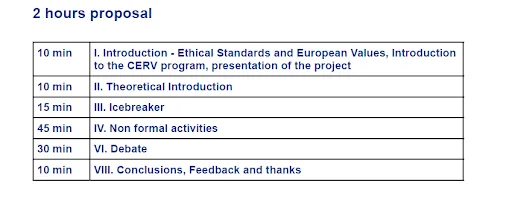
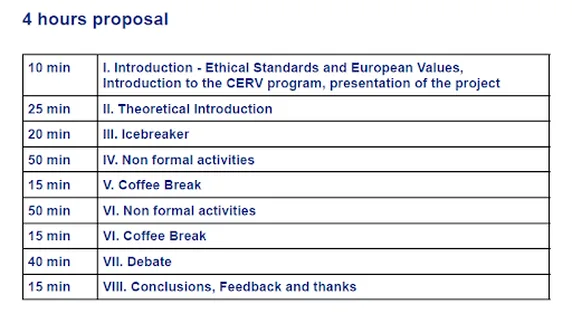
Agenda (2 proposals)