Introduction
This workshop is dedicated to Youth Leadership and Empowerment. Its goal is to explore how young people, aged between 15 and 25, can not only actively participate in political and civic life, but also become leaders in their communities. This course is part of the CERV project ‘Youth DemocrAID’, which aims to strengthen youth participation in democratic life and promote active citizenship. We live in an era in which the role of young people is increasingly crucial. Global challenges – such as climate change, social inequalities, misinformation and the crisis of democracy – call for an active and conscious participation of the younger generation. However, young people often face social, cultural and economic barriers that limit their full involvement. This is why it is crucial to talk about youth empowerment.
What is youth empowerment?
The term ’empowerment’ refers to the process by which people gain more control over their lives, develop critical awareness and increase their ability to make decisions. For young people, this means acquiring skills, knowledge and confidence to influence decision-making processes in their communities, politics and institutions. Empowerment is not only individual, but also collective: through active participation, young people can unite, support each other and build movements capable of generating concrete change.
Youth leadership: driving change
Youth leadership is based on the idea that young people are not simply recipients of policies or initiatives, but key players who can drive change. Being a leader means taking responsibility for influencing and inspiring others, promoting dialogue and actively contributing to problem solving. In a democratic context, leadership is not just about power, but about service and vision: young leaders must be able to listen, facilitate participation, build consensus and promote values of equity, inclusion and justice.
The role of political participation and active citizenship
Part of our goal today is to understand how young people can be an integral part of political life and active citizenship. Youth political participation is not limited to voting, but includes a range of activities, such as volunteering, involvement in local associations, participation in social movements and the use of digital platforms to influence public debate. Being active citizens also means developing a critical awareness of the power dynamics and inequalities that characterize society. This workshop aims to provide practical and theoretical tools so that you can acquire the necessary skills to become protagonists of this change.
The goals of the workshop
1. Developing leadership skills: Through practical activities, discuss how to build self-confidence, communicate effectively and work in teams to solve problems.
2. Promoting active citizenship: Explore the different ways in which young people can participate in public and political life, both locally and globally, and explore how you can make a difference in your communities.
3. Empowerment through awareness: Trying to understand how social, cultural and economic dynamics influence youth participation, and how to overcome the barriers that hinder your full inclusion.
4. Networking and intergenerational collaboration: Make connections with other young leaders and activists of different ages to exchange ideas and build concrete projects that can have a real impact.
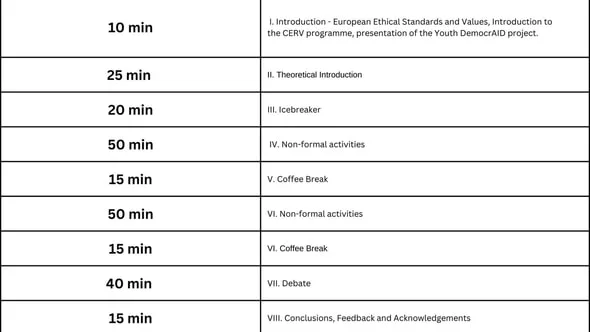
Agenda
Proposal for 2 hours
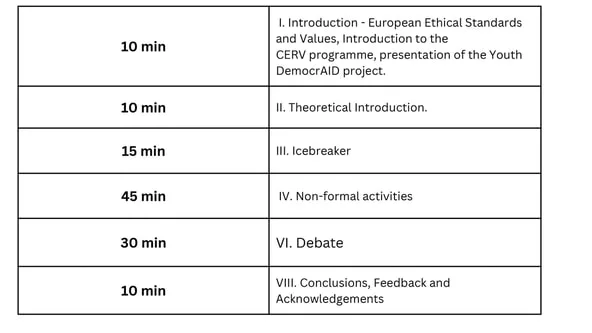
Proposal for 4 hours