Introduction
This workshop focuses on Political Participation and Advocacy and is part of the Youth DemocrAID project under the European Union’s CERV programme (Citizens, Equality, Rights and Values). Its goal is to help young people, aged 15–25, understand the role they can play in shaping democratic societies—both through formal political processes and through informal, community-driven action.
Across Europe, and particularly in Greece, youth participation in traditional political structures has declined. However, young people continue to find new and creative ways to engage, especially through digital tools and social movements. This workshop aims to harness that energy and curiosity by offering a hands-on experience in political reflection, debate, and planning.
What is political participation and advocacy?
Political participation refers to the different ways in which citizens—especially youth—engage in political life to influence decisions, policies, or leaders. It can include voting, joining political parties, protesting, volunteering, or advocating for social causes. Participation is often divided into:
- Conventional forms (e.g., voting, campaigning),
- Unconventional forms (e.g., demonstrations, online activism, grassroots movements).
Advocacy, on the other hand, refers to actions taken to support or promote specific causes or rights. It includes strategies like campaigns, petitions, public speaking, and engagement with institutions. It’s a vital part of strengthening democracy, transparency, and social justice.
This workshop introduces both concepts and helps participants explore how they can use them to address local and global challenges—from mental health to climate change.
Youth leadership: taking initiative for change
Youth leadership in this context means more than occupying formal roles—it’s about taking initiative, developing a voice, and organizing for change. Throughout the workshop, participants create and lead campaigns, participate in rapid-fire debates, and even simulate media engagement through a final press-style discussion with a political representative.
In doing so, they develop critical leadership skills such as:
- Strategic thinking and decision-making
- Public communication
- Empathy and inclusion
- Organizing and planning
- Questioning and holding power accountable
Leadership here is not top-down—it is collective, dialogical, and grounded in real-world concerns and collaboration.
The role of political participation and active citizenship
Political participation is more than voting—it’s about making your voice heard and influencing the world around you. Today’s youth are faced with social, environmental, and economic challenges that demand active citizenship and informed decision-making.
This workshop encourages youth to:
- Understand political systems and their rights
- Recognize the power of direct action, campaigns, and advocacy
- Use digital tools to raise awareness and mobilize support
- Engage respectfully with opposing views
- Contribute to democratic processes at the community level
By blending education with action, the workshop fosters a deeper connection between young people and their role in shaping democratic societies.
The goals of the workshop
- Promote democratic awareness: Help participants understand political structures, rights, and forms of engagement (traditional and modern).
- Develop critical thinking and debate skills: Through speed-debating and reflection, foster the ability to analyze issues and argue constructively.
- Encourage collaborative action: Guide participants in creating campaigns using real tools like petitions, protests, and social media.
- Support civic identity building: Foster a sense of responsibility and belonging as citizens capable of initiating change.
- Empower political communication: Strengthen public speaking, questioning, and dialogue through a final press-style discussion with a political guest.
Bridge knowledge and action: Connect abstract concepts (like democracy, participation, advocacy) with real, practical applications through gamified and participatory activities.
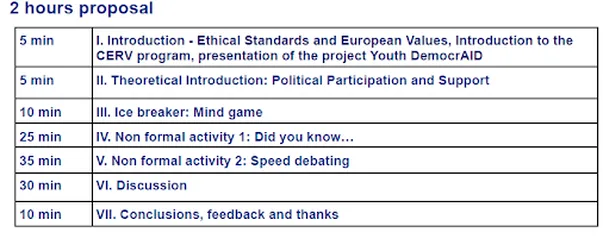
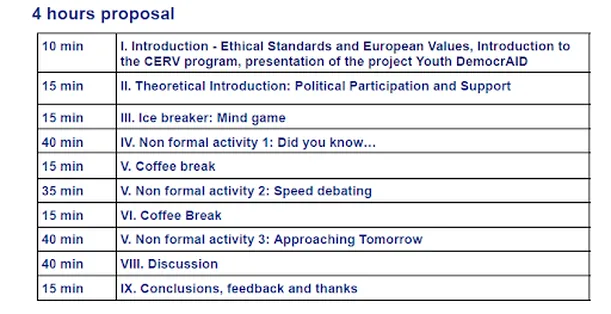
Agenda (2 proposals)